How I choose the right locum tenens assignments: A guide from my time on the road

Camille Drew, author of this post Camille Drew • Follow
Calendar icon February 20, 2026 • 10 min • Share icon
Smiling healthcare worker in scrubs and an Aya jacket holding anesthesia breathing equipment in a hospital setting.

Summary

  • Learn how to evaluate locum tenens assignments by aligning location, practice setting, schedule and compensation with your personal and professional goals.
  • Discover how flexibility, financial control and diverse clinical experiences can support both lifestyle freedom and long-term career growth.
  • Plan smarter assignments using a practical checklist and must-ask recruiter questions to avoid surprises and set clear expectations.
  • Design a locum tenens career with intention — partnering with a trusted agency to navigate logistics, stay adaptable and focus on patient care.

If you’re exploring locum tenens work — or if you’re already in the field and want to be more intentional about your assignments — I hope my experience can give you a helpful, realistic roadmap. After four years as a CRNA locum provider and now currently on assignment with Aya Locums (shoutout to my recruiter, Greg, who truly goes above and beyond!), I’ve learned how to evaluate opportunities in a way that supports my career, my lifestyle and, most importantly, my patients.

Here’s my approach when choosing an assignment, what I’ve learned along the way and a little advice I wish someone had shared with me when I first started my locum tenens journey.

Why I chose locum tenens work: Flexibility is everything

I was drawn to locum tenens for the same reason many are: flexibility. I wanted to build a schedule that worked for me — one that allowed room for travel, downtime and a little adventure. Locum tenens gave me the freedom to try new hospitals, meet new teams and gain experience across different care environments, all while staying in control of my hours.

Four years in, I can confidently say it’s been an amazing decision for my lifestyle. I work when I want, where I want — within reason — and I’m still able to provide support in locations where they genuinely need help, whether that’s covering a weekend or pitching in during high-volume periods. Professionally, I feel I’ve gained skills and perspectives I never would have had in a single permanent role.

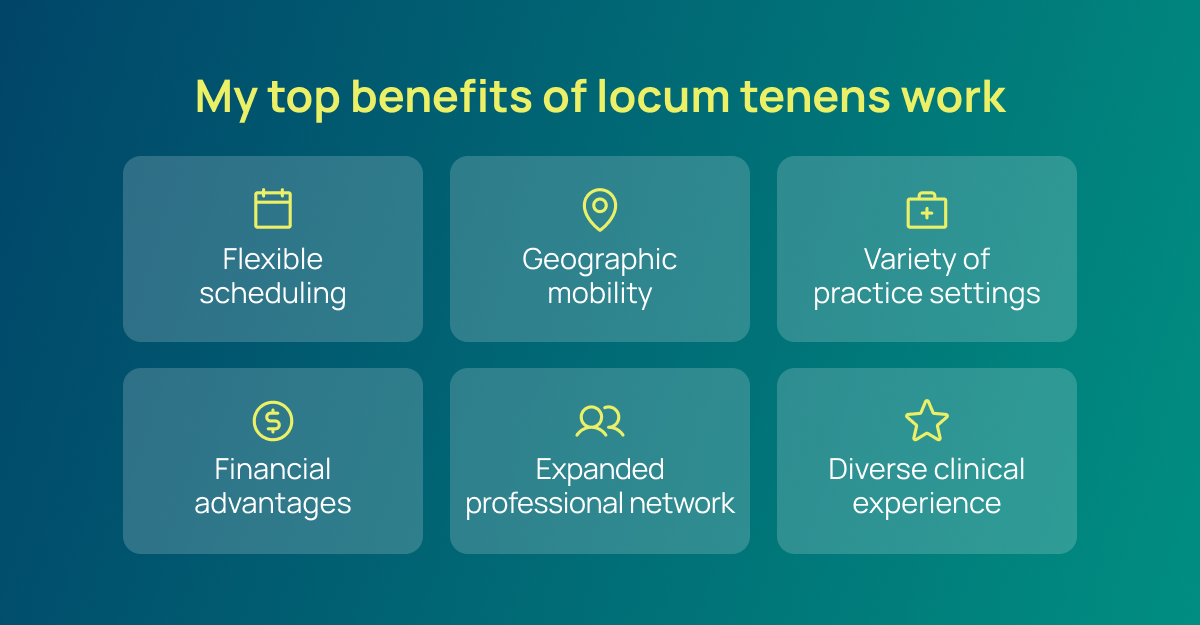
Infographic titled “My top benefits of locum tenens work” listing flexible scheduling, geographic mobility, variety of practice settings, financial advantages, expanded professional network, and diverse clinical experience.

The power of purpose: What keeps me practicing as a locum

I don’t have one defining moment that keeps me grounded in this work — it’s the people.

Every time a patient shares a personal story, trusts me during a vulnerable moment or simply expresses gratitude, I’m reminded why I love practicing medicine. That feeling extends to colleagues, too. As a locum provider, it can be intimidating to walk into a new facility, so when a team welcomes you with open arms, it makes a huge and lasting impact.

How locum tenens gives me control and stability

One of the best parts of locum work is the opportunity to design your life, not just your job. I know locums who work every other week, others who take a full month off between assignments and some who choose to stay working year-round. I’m working toward that rhythm myself, but even now, I have full control over how much I work — and when.

Design your locum lifestyle

Ready to choose when and where you work? Register with Aya Locums to explore flexible CRNA opportunities that align with your goals, schedule and sense of adventure.

Register today!

How I choose assignments

Choosing the right locum assignment isn’t just about logistics — it’s about aligning your personal needs, professional goals and lifestyle preferences. Here’s how I approach it.
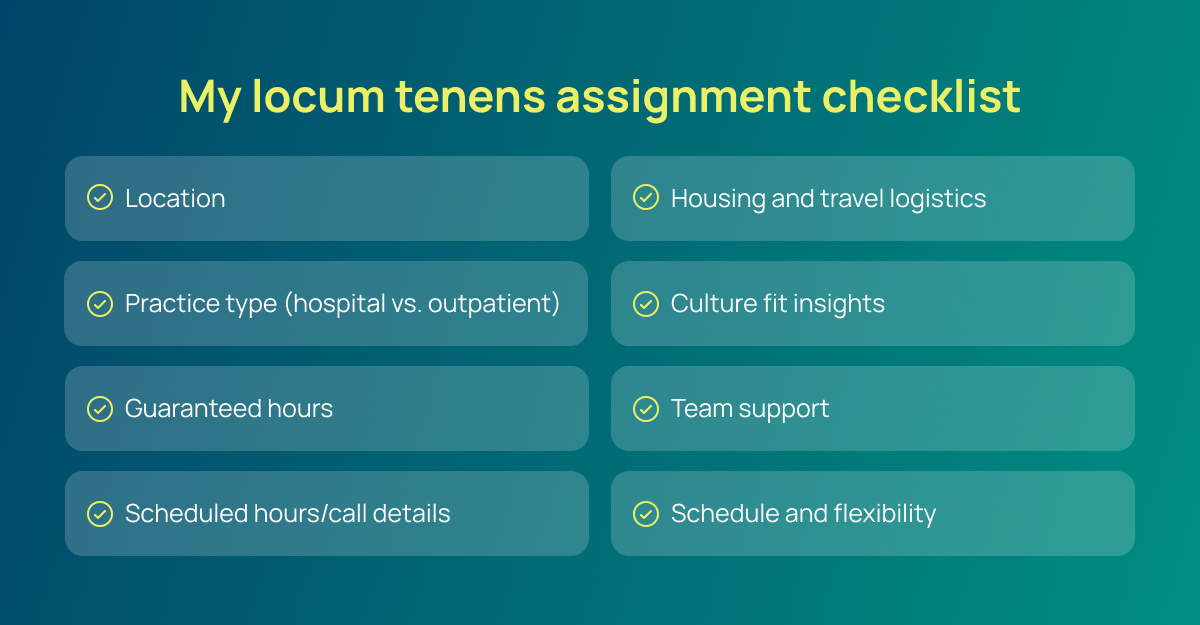
Checklist titled 'My locum tenens assignment checklist' with items including location, practice type, guaranteed hours, scheduled call details, housing and travel logistics, culture fit insights, team support, and schedule flexibility.

1. Location comes first

Right now, location is my number one priority. After spending about four years in the same general area, I’m ready to explore new parts of the country. Locum tenens makes adventure accessible — you can go almost anywhere in the U.S.!

2. Type of practice shapes your day-to-day

After location, I evaluate the practice setting. Most of my experience is in hospital settings, which naturally feels like home. But locum tenens gives me the option to step into outpatient facilities if I want something different. That variety is one of the biggest benefits of this career path.

3. Supportive teams matter — especially early on

When I first started, team support was a very important factor. Switching paths and stepping into a new environment can be nerve-wracking, so having a collaborative team can make all the difference.

Now, with more experience, I feel comfortable adjusting to new teams quickly, but supportive staff can still completely change your experience at a facility. I’ve been very fortunate to have a great recruiter and have leaned on Aya Locums’ experience team to offer advice and help facilitate onboarding, which makes the transitions so much easier!

4. Compensation, housing and travel logistics are key

As I look further from home, housing options and compensation all play a bigger role. If I’m going to uproot for a few months, I want to be sure the financials support that decision. Thankfully, I can rely on my recruiter and Aya Locums team to help me navigate these details, too.

5. Schedule, call and workload need to align with your life

I’m fortunate to have the flexibility to work almost any daytime schedule (I personally don’t prefer nights). And I don’t mind helping with weekend coverage when needed, because facilities often rely heavily on locums to bridge staffing gaps. I suggest using transparent websites that clearly list a facility’s scheduling expectations, so you can quickly determine if an assignment aligns with your lifestyle.

6. Culture fit: The hardest thing to predict

While culture fit can be tricky, I’ve never found it to be an issue. Two people can have completely different experiences at the same site, so I’ve learned to approach each assignment with an open mind and realistic expectations. A good recruiter can also be incredibly valuable here, too, by providing feedback from previous clinicians.

Additionally, I’ve turned to online forums and clinician groups for insight, but nothing replaces experiencing it firsthand.

7. My must-ask questions before accepting an assignment

Before signing on, I always ask my recruiter:

  • Are there guaranteed hours?
    If I’m scheduled for 40 hours, I want to know I’ll be compensated for 40 hours.
  • What does pay look like for hours outside those that I am regularly scheduled for?
    I pick up extra shifts occasionally, so I want clarity on how those hours are paid.

Those two questions alone can make or break an assignment for me.

8. Dealbreakers and lessons learned

I haven’t encountered any true dealbreakers so far, and I’m open to different types of assignments. I will say, though, that as I’ve gained locum experience, I’ve learned to prioritize compensation for required call or overtime, which wasn’t something I really considered much when I first started locum tenens.

My advice for considering locum tenens

If you’re thinking about taking the leap, here’s a few notes to keep in mind:

Have fun. Explore. Be open-minded.

Locum roles let you design a career that many clinicians only dream of — but remember why you’re there. You’re helping a facility bridge a staffing gap and care for patients who truly need you. Stay flexible, humble and focused on providing exceptional care.

Don’t do it alone!

Working with a reputable agency and an experienced recruiter are essential to having a successful locum tenens career. Aya Locums makes it simple to step into my assignments with confidence. Their team helps with everything — licensing, travel, housing, pay, malpractice and seamless onboarding — so I can focus on my patients.

Locum tenens has given me freedom, financial stability, professional growth and personal fulfillment — and if you approach it with intention, it could likely do the same for you.

All information, discussions and opinions contained within this blog or otherwise on the website or any linked materials (the “Blog Content”) is for general informational purposes only.  All Blog Content is based on the author’s opinions and experiences and is not necessarily representative of our opinions as an organization. It should not be considered as tax/financial advice, legal advice, compliance advice, health advice or other professional advice and does not constitute the practice of any medical, nursing or other professional healthcare advice, diagnosis or treatment or provision of legal services. You should seek professional assistance for any concerns or issues. If you or any other person has a medical concern, you should consult with your healthcare provider or seek other professional medical treatment immediately. While we strive to provide accurate and up-to-date information, we make no warranties or representations regarding the completeness, reliability, or accuracy of the Blog Content. Your use of the Blog Content is solely at your own risk and we will not be liable for any damages or losses arising from the use of, or reliance on, any Blog Content.

Camille Drew, author of this post
Camille Drew

Camille Drew is an experienced Certified Registered Nurse Anesthetist (CRNA) with more than a decade of clinical practice across diverse care settings. She’s worked as both a W-2 employee and a locum tenens provider, giving her a unique perspective on flexibility, work-life balance and the evolving needs of healthcare facilities. Passionate about patient-centered anesthesia care, Camille brings adaptability, clinical expertise and a commitment to supporting teams and patients wherever she practices.

Learn more about Camille Drew